

What a Soft Starter Does at Start-Up
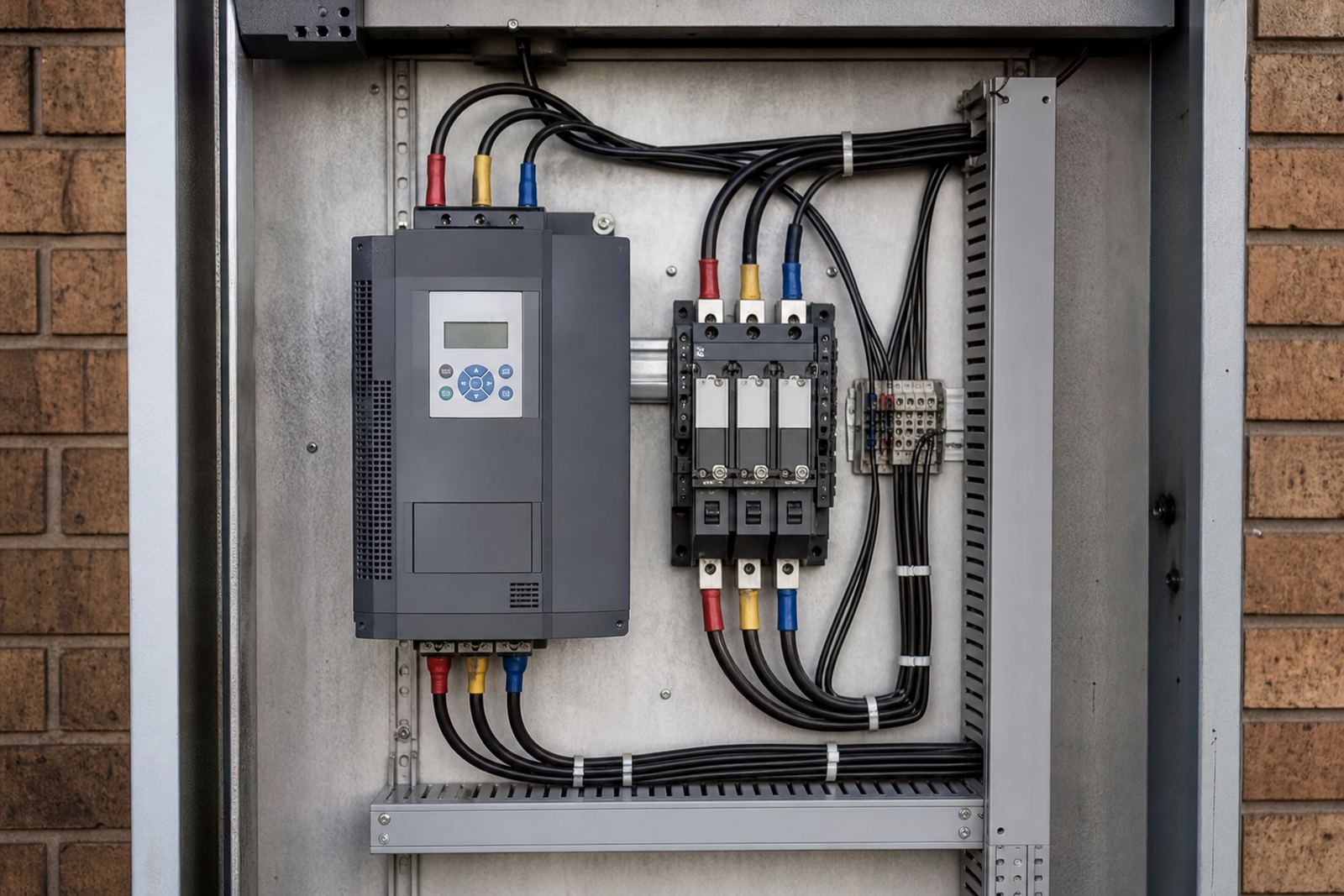
A soft starter limits the voltage applied to the motor at the moment it begins turning, then ramps it up in a controlled way. Instead of the motor taking a sudden full current hit, the unit allows the shaft to come up to speed more gradually, which helps reduce mechanical shock and electrical stress.
This is useful on equipment that starts under load, such as compressors, conveyors, fans, crushers and certain pump sets. In practical terms, it can reduce belt slip, pipe hammer and the hard jolting that often shows up after repeated starts on a busy shift.
Why Motor Systems Benefit from a Gentler Start
Every direct-on-line start asks a lot from the motor and the supply. The inrush current is high, the torque rise is sudden and the rest of the machine feels that force straight away. Over time, that can show up as loose terminals, worn bearings, cracked couplings and damaged seals.
A soft starter does not remove all stress, but it reduces the peak shock at the most demanding moment. That matters on older installations, on plants with long cable runs, and where load-shedding has left equipment cycling on and off more often than it should.
- Less strain on bearings and couplings during start-up
- Lower risk of nuisance tripping on weak supply points
- Reduced mechanical wear on pumps, fans and gearboxes
- Better control when equipment must start under load
Where Soft Starters Fit in South African Plants
Across Gauteng, KZN and other industrial areas, soft starters are common on fixed plant that must start safely and predictably. In Germiston workshops and Ekurhuleni plants, they are often used on systems that cannot afford repeated hard starts because downtime quickly becomes expensive and messy.
A local example is a workshop air compressor that starts several times a day. If the supply is already under pressure from other equipment, a soft starter can help the compressor come in more smoothly and reduce disturbance on the board. That said, it is still important to size the starter correctly for the motor and the actual duty cycle, not just the nameplate rating.
When a Soft Starter Is the Right Choice
Soft starters are a good fit where the aim is to reduce starting stress rather than control running speed. They are often used on fixed-speed motors that need a controlled ramp-up and ramp-down, especially where the driven machine is sensitive to shock.
They are not the same as a variable speed drive. A drive changes speed during running, while a soft starter mainly manages the start and stop sequence. Choosing between the two depends on the process, the load and the level of control needed. If the machine only needs a gentler start, a soft starter may be the simpler option.
- Conveyor systems with heavy starting load
- Fans and blowers that need smoother acceleration
- Pumps where water hammer must be reduced
- Compressors and other fixed-speed rotating plant
What Proper Installation and Checks Should Cover
Soft starters must be installed and checked by qualified people, with proper lockout procedures before any work begins. Electrical panels can hold dangerous stored energy even after a supply is switched off, so the safe approach is to isolate, verify and only then touch the equipment.
A proper site visit usually includes fault finding, motor removal where needed, drive inspection, bearing checks, insulation testing, alignment checks, panel cleaning and cable checks. Site reporting also helps when the same issue keeps returning, because it shows whether the problem started in the motor, the starter, the cables or the load itself.
- Isolate the circuit and confirm lockout before opening panels
- Check terminal tightness, contact points and signs of heat damage
- Test insulation and compare results with previous readings
- Inspect the motor load for binding, misalignment or worn bearings
A Practical View for Workshops and Shutdown Planning
For sites in Pretoria, Vereeniging, Boksburg and Kempton Park, soft starter issues often turn up during planned shutdowns or after a fault on a heavy motor. That is why shutdown planning matters. It gives time to inspect the starter, assess spares, clean the panel and confirm the motor is ready before the line goes back into service.
Good commissioning support does not stop at switching the motor on. It includes watching the start profile, checking current draw and making sure the motor does not trip when the plant is put back under real load. A starter that looks fine on paper can still struggle if the load has changed, or if the motor has hidden winding damage. Small checks now can save a long breakdown later, and that is worth doing properly.
Why Soft Starter Basics Matter Before the Next Breakdown
Soft starters are not complicated once you strip away the jargon. They simply help a motor start with less shock, which protects the machinery around it and gives operators more control over the first few seconds of running.
For plants and workshops that rely on stable starting, the main point is this: the starter must suit the motor, the load and the site conditions. In humid coastal areas, dusty workshops and plants dealing with load-shedding or older switchgear, that basic fit can make all the difference.